Blog Details
ICH Q1A(R2) Stability Testing: A Complete Guide for Pharma Manufacturers

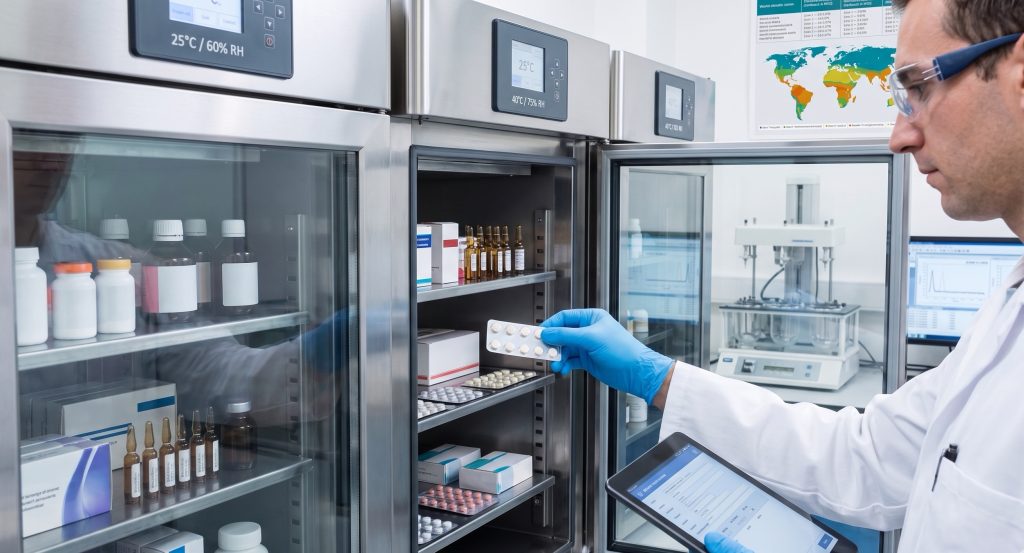
Stability testing is a non-negotiable requirement for drug approval and ongoing product quality assurance. ICH Q1A(R2), the internationally harmonised guideline for stability testing of new drug substances and products, defines the conditions, timepoints, and data requirements that regulators in the US, EU, Japan, and beyond expect to see in a registration dossier. This guide gives pharmaceutical manufacturers a clear, practical understanding of what ICH Q1A (R2) requires and how to build a compliant stability program.
What Is ICH Q1A(R2)?
ICH Q1A(R2) is a guideline developed by the International Council for Harmonisation of Technical Requirements for Pharmaceuticals for Human Use. It specifies the data package needed to establish a shelf life for new chemical entities (NCEs) and their drug products. The '(R2)' designation indicates it is the second revision, which has been in effect since 2003.
The guideline applies to both new drug substances (APIs) and new drug products (finished dosage forms), including tablets, capsules, liquids, injectables, and more.
The Four ICH Climate Zones
ICH divides the world into four climatic zones, each representing a different environmental stress condition. Your target market determines which zone conditions you must test under.
- Zone I – Temperate: 21°C / 45% RH (e.g., UK, Northern Europe)
- Zone II – Subtropical/Mediterranean: 25°C / 60% RH (e.g., USA, Japan, EU)
- Zone III – Hot and Dry: 30°C / 35% RH (e.g., Middle East)
- Zone IVa – Hot and Humid: 30°C / 65% RH (e.g., Brazil, parts of Asia)
- Zone IVb – Hot and Very Humid: 30°C / 75% RH (e.g., India, Southeast Asia, sub-Saharan Africa)
Most global registration dossiers require data at Zone II conditions (25°C/60% RH) at minimum. Applications targeting markets in Zone IVb must include data at 30°C/75% RH.
Required Testing Conditions
Long-Term Testing
Long-term studies are conducted under conditions representing the intended storage environment. For Zone II, the standard long-term condition is 25°C ± 2°C / 60% ± 5% RH. Data is generated at 0, 3, 6, 9, 12, 18, and 24 months, then annually through the proposed shelf life.
Accelerated Testing
Accelerated studies use elevated conditions, typically 40°C ± 2°C / 75% ± 5% RH to predict shelf life and identify potential degradation pathways faster. Accelerated testing is typically run for 6 months with testing at 0, 3, and 6 months.
Intermediate Testing
Intermediate testing at 30°C ± 2°C / 65% ± 5% RH is triggered when a product shows significant change at accelerated conditions. It bridges the gap between accelerated and long-term data and is required in some regulatory submissions.
Important: Significant change at accelerated conditions triggers mandatory intermediate testing and may require reassessment of the proposed shelf life.
What Constitutes 'Significant Change'?
ICH Q1A(R2) defines significant change for drug products as any of the following:
- A 5% loss in potency from initial assay value
- Any degradation product exceeding its acceptance criterion
- Failure to meet acceptance criteria for appearance, physical attributes, or functionality tests
- pH falling outside acceptable limits (for liquid dosage forms)
- Dissolution failure for 12 of 12 units tested
Storage Conditions for Drug Substances
For new drug substances, ICH Q1A(R2) requires the same long-term, accelerated, and intermediate conditions as drug products. Additionally, stress testing including thermal degradation, humidity exposure, is required to characterise inherent stability and degradation pathways.
Packaging Considerations
Stability studies must be conducted in the proposed commercial packaging or a simulated representative pack. Container closure integrity is critical, semi-permeable containers (e.g., LDPE bottles, PVC blisters) require specific testing provisions under the guideline.
Data Evaluation and Shelf-Life Estimation
Shelf life is determined by statistical analysis of degradation data over time. ICH Q1E (Evaluation of Stability Data) provides the statistical methodology, including regression analysis with 95% one-sided confidence intervals. The proposed shelf life cannot exceed the period covered by available long-term data at the time of submission without adequate justification.
Equipment Requirements for ICH Q1A(R2) Compliance
Stability chambers used for ICH-compliant studies must be capable of maintaining precise temperature and humidity setpoints with validated uniformity across the full chamber volume. Key requirements include:
- Temperature accuracy: ±2°C of setpoint throughout the chamber
- Humidity accuracy: ±5% RH of setpoint
- Continuous data logging with time-stamped, audit-trail-capable records
- Validated alarm systems for out-of-specification (OOS) deviations
- IQ/OQ/PQ documentation and periodic requalification
ICH Q1A(R2) compliance is foundational to drug approval and product lifecycle management. Understanding the required conditions, timepoints, and data expectations allows you to design a stability program that supports global registration from the outset. Investing in properly validated stability chambers and robust data management systems is not just a regulatory requirement, it is a business-critical quality investment.
Our range of ICH-compliant stability chambers is designed to meet the precise environmental requirements of Q1A(R2) studies, with built-in data logging and alarm systems ready for your validation process.