Blog Details
Remote Monitoring and Alarms: Why Real-Time Alerts Matter in Stability Testing
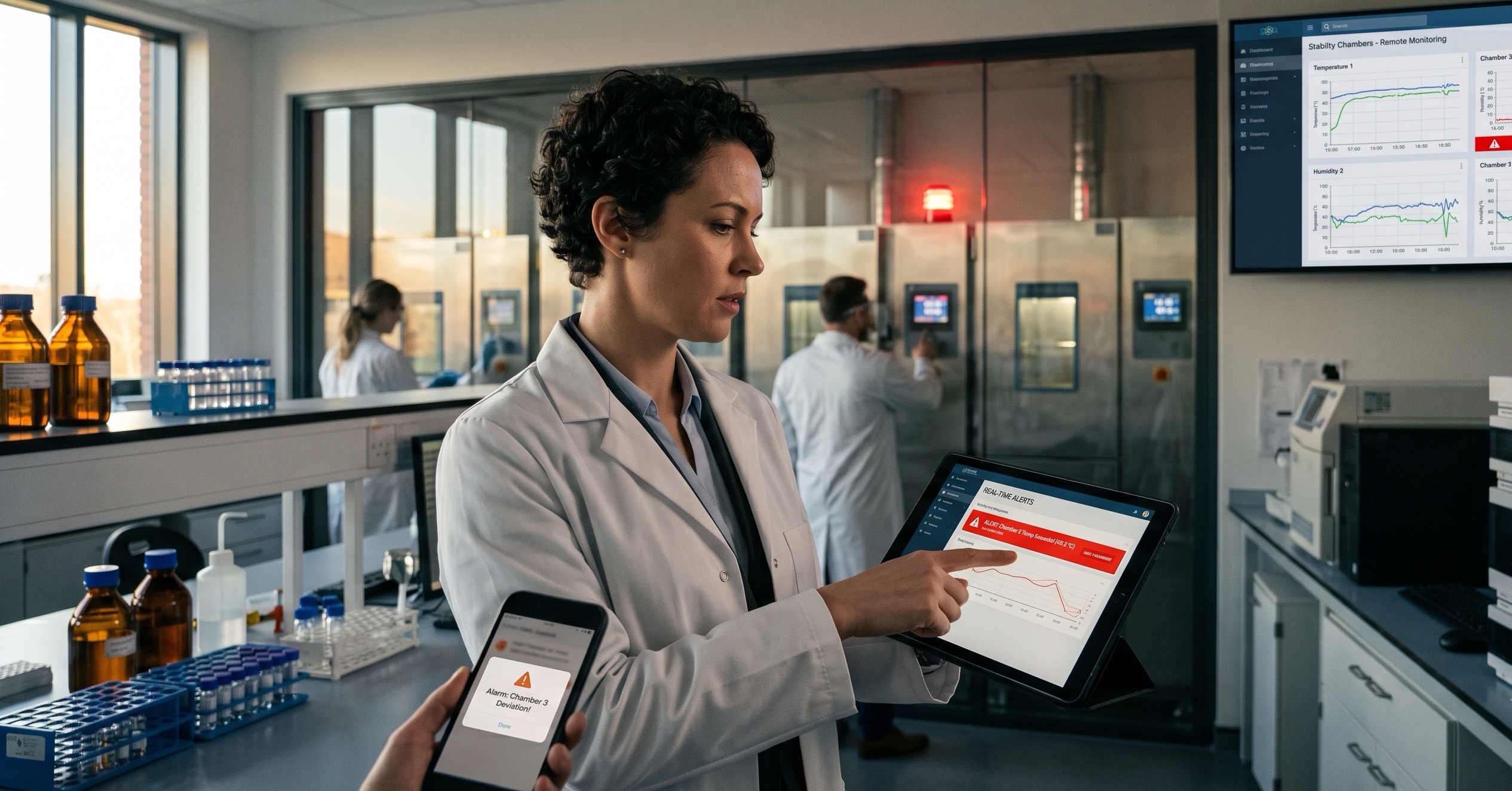
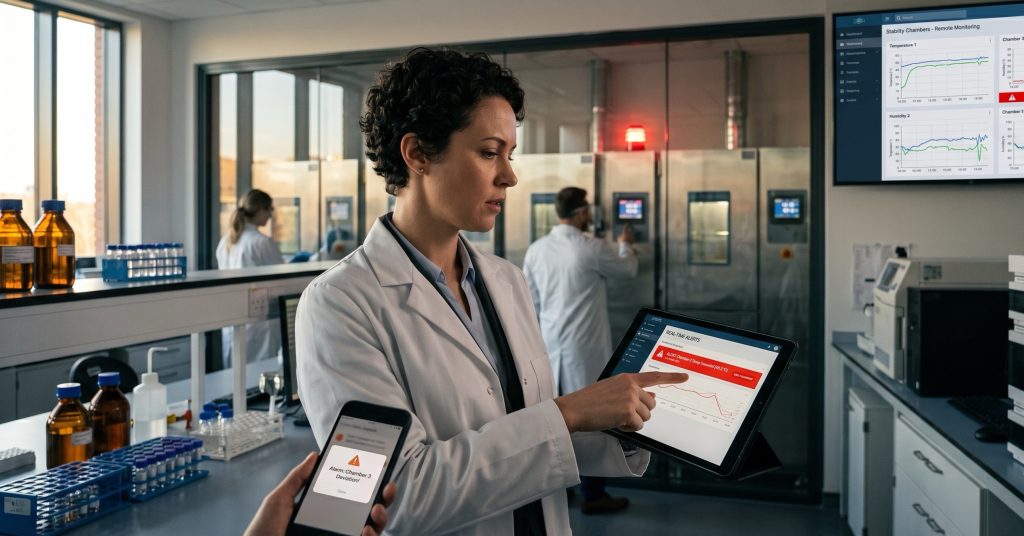
A stability study can take months or years to complete, and the integrity of that entire dataset rests on uninterrupted, controlled storage conditions. A temperature excursion lasting just a few hours can invalidate months of work, compromise product quality, and trigger costly regulatory investigations. Remote monitoring and real-time alarm systems are the last line of defence between a recoverable incident and a catastrophic data loss event.
The Risk Landscape in Stability Storage
Stability chambers operate continuously, nights, weekends, and public holidays included. Equipment failures, power outages, refrigerant leaks, door seal failures, and sensor faults can all cause environmental deviations. Without active monitoring, these events may go undetected for hours.
In a GMP environment, every excursion must be documented and investigated. Repeated or prolonged excursions can call into question the validity of stored samples and may require a study to be restarted, a significant cost in both time and resources.
What Is Remote Monitoring for Stability Chambers?
Remote monitoring systems continuously track temperature, humidity, CO₂ (where applicable), and equipment status from stability chambers, cold rooms, incubators, and freezers. Data is transmitted in real time to a central platform — accessible via web browser or mobile app, where it is logged, trended, and compared against user-defined alarm thresholds.
Modern systems typically include:
- Continuous data logging at configurable intervals (e.g., 5 minutes to 60 minutes+)
- High and low alarm thresholds for temperature and humidity
- Multi-channel alerting via SMS, email, and/or push notification
- Escalation chains: primary contact → secondary contact → on-call engineer
- Audit trail and 21 CFR Part 11 / Annex 11 compliant data storage
- Dashboard views for multiple chambers across multiple sites
Why Real-Time Alerts Are Non-Negotiable
Protecting Sample Integrity
ICH Q1A(R2) requires that stability samples be stored under precisely defined, validated conditions. Any deviation must be investigated and its impact on sample integrity assessed. Real-time alerts enable personnel to respond quickly, often within the equipment's recovery window, minimising or eliminating the impact of an excursion.
Regulatory Compliance
Both FDA 21 CFR Part 211 and EU GMP Annex 15 require documented evidence that storage conditions were maintained throughout a study. A remote monitoring system with a compliant data trail provides continuous, irrefutable evidence and significantly simplifies regulatory submissions and inspections.
Reducing Human Error
Manual temperature log checks, even when performed diligently are periodic snapshots. A sensor reading at 8 AM and 4 PM tells you nothing about what happened at 2 AM. Automated monitoring removes the reliance on manual checks and provides a complete, unbroken data record.
Business Continuity
The financial cost of a failed stability batch, restocking, repeat studies, delayed submissions, or product recalls far outweighs the cost of a monitoring system. Real-time alerts allow facilities teams to respond to equipment faults outside of business hours, protecting both product and program timelines.
Key Features to Look For
- 21 CFR Part 11 / EU Annex 11 compliance with audit trail and electronic signatures
- Redundant alarm delivery paths (SMS + email)
- Configurable escalation chains with acknowledgement tracking
- Data storage with defined backup and disaster recovery
- Inter-site dashboard for enterprise-level visibility
Remote Monitoring as a Validation Asset
Beyond operational protection, a robust remote monitoring system also generates the continuous environmental data that supports PQ requalification and trend analysis. When regulators ask for evidence of ongoing performance within qualified parameters, a system with historical data export capability makes compliance straightforward.
Real-time remote monitoring is no longer an optional add-on for pharmaceutical stability labs, it is an operational and regulatory necessity. The combination of continuous data logging, instant alarm notification, and audit-ready records protects your samples, your studies, and your regulatory standing.
All of our stability chambers, incubators, photo stability and cold rooms are compatible with NIV-DAS, our 21 CFR Part 11 compliant remote monitoring software. Ask our team about integrated monitoring solutions for your facility.